

 Peer-reviewed paper. Joanna C. Pollard, Conservation 2025, volume 5, issue 3, article 47. Published online 3 September 2025.
Towards Ethical and Effective Conservation of New Zealand’s Natural Heritage
This is the international, peer-reviewed account of the case for changing New Zealand conservation management. The journal version is the citation of record. The abstract below is reproduced unchanged.
Pollard, J.C. Towards Ethical and Effective Conservation of New Zealand’s Natural Heritage. Conservation 2025, 5(3), 47.
https://doi.org/10.3390/conservation5030047
Read the full paper | Download the journal PDF
In brief
The paper examines seventy years of aerial poisoning aimed at possums and rats, and the increase in intensity, frequency and scale being trialled under Predator Free 2050. It sets out the case for a shift to targeted, monitored and more humane management, with remote monitoring and self-resetting kill traps among the tools, and with all relevant stakeholders involved, in order to protect what remains of New Zealand’s natural heritage.
Abstract
Major human impacts on New Zealand’s ecology began about 800 years ago with immigration firstly from Polynesia, then Europe starting a few centuries later. The humans cleared habitat, hunted species to extinction, and introduced biota, including plants, birds, fish, invertebrates, and mammals. Over the last 70 years, government-funded campaigns have been waged against some of the introduced mammals that became considered harmful to native biota. These campaigns spread poisonous food baits from aircraft to kill and suppress target animals (mainly brushtail possums (Trichosurus vulpecula) and rats (Rattus spp.)) over large areas. Increased intensity, frequency, and scale of poisoning are being trialled under a new conservation strategy (Predator Free 2050) to eradicate several mammalian species. The present study investigates the opportunity for a paradigm shift in conservation, emphasizing the rationales for transitioning from spreading of pesticides to a more targeted approach. NZ’s poison- and predator-focused ecological management has been criticized internationally as cruel and unnecessary, while independent NZ ecologists have called for, and outlined, a new system of conservation management based on ecological knowledge, which embraces all threats to native biota. A central tenet of proposed new methods is the engagement of all relevant stakeholders. Efficient management tools include remote monitoring, and smart, self-resetting kill traps for targeted small mammal control. Ecology-driven, commercially sound, targeted, monitored, relatively humane management can be implemented to protect the remnants of NZ’s natural heritage.
This abstract is reproduced unchanged from the published paper. The paper is available under the Creative Commons Attribution 4.0 International licence (CC BY 4.0). Cite the author, the journal and the DOI above. No changes have been made to the abstract.
Related reading on this site
- Report on killing wildlife to control bovine tuberculosis in New Zealand (December 2025)
- A critique of the research used to justify kea poisoning (30 August 2026)
- Animal welfare
- Managing wild animal populations without the cruelty of 1080
Tony Orman reported on this paper for the Council of Outdoor Recreation Associations of New Zealand: Conservation scientist urges a change from aerial 1080 poison to a new enlightened programme (25 September 2025).
Latest 1080 Science Press Releases
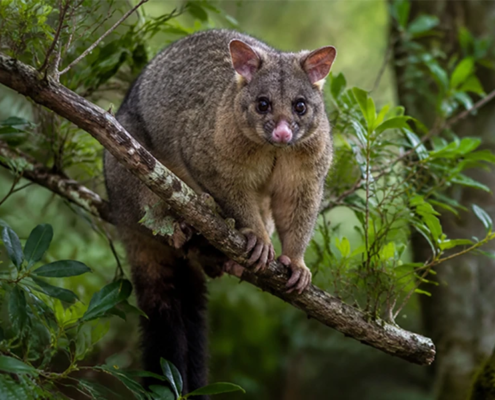 https://1080science.co.nz/wp-content/uploads/2026/08/nz-possum.webp
600
1200
Dr J.C. Pollard, BSc (Hons), PhD, Zoology
http://1080science.co.nz/wp-content/uploads/2013/04/logo1-300x79.jpg
Dr J.C. Pollard, BSc (Hons), PhD, Zoology2026-08-08 08:58:352026-09-26 07:36:27Managing Wild Animal Populations Without the Cruelty of 1080
https://1080science.co.nz/wp-content/uploads/2026/08/nz-possum.webp
600
1200
Dr J.C. Pollard, BSc (Hons), PhD, Zoology
http://1080science.co.nz/wp-content/uploads/2013/04/logo1-300x79.jpg
Dr J.C. Pollard, BSc (Hons), PhD, Zoology2026-08-08 08:58:352026-09-26 07:36:27Managing Wild Animal Populations Without the Cruelty of 1080 https://1080science.co.nz/wp-content/uploads/2025/01/OIA.jpg
600
1200
Dr J.C. Pollard, BSc (Hons), PhD, Zoology
http://1080science.co.nz/wp-content/uploads/2013/04/logo1-300x79.jpg
Dr J.C. Pollard, BSc (Hons), PhD, Zoology2025-01-12 04:10:302026-08-08 09:36:46DOC Response to OIA Request on 1080 Poison Use and Karoro Deaths
https://1080science.co.nz/wp-content/uploads/2025/01/OIA.jpg
600
1200
Dr J.C. Pollard, BSc (Hons), PhD, Zoology
http://1080science.co.nz/wp-content/uploads/2013/04/logo1-300x79.jpg
Dr J.C. Pollard, BSc (Hons), PhD, Zoology2025-01-12 04:10:302026-08-08 09:36:46DOC Response to OIA Request on 1080 Poison Use and Karoro Deaths https://1080science.co.nz/wp-content/uploads/2023/09/piwakawaka-FB.jpg
600
1200
Dr J.C. Pollard, BSc (Hons), PhD, Zoology
http://1080science.co.nz/wp-content/uploads/2013/04/logo1-300x79.jpg
Dr J.C. Pollard, BSc (Hons), PhD, Zoology2023-09-19 00:01:122023-09-19 03:58:39In-depth Response: Independent Scientist, Jo Pollard, Debunks OSPRI’s Claim that a 10-Year Study Proves Forests Remain Vibrant Despite 1080 Poison Usage!
https://1080science.co.nz/wp-content/uploads/2023/09/piwakawaka-FB.jpg
600
1200
Dr J.C. Pollard, BSc (Hons), PhD, Zoology
http://1080science.co.nz/wp-content/uploads/2013/04/logo1-300x79.jpg
Dr J.C. Pollard, BSc (Hons), PhD, Zoology2023-09-19 00:01:122023-09-19 03:58:39In-depth Response: Independent Scientist, Jo Pollard, Debunks OSPRI’s Claim that a 10-Year Study Proves Forests Remain Vibrant Despite 1080 Poison Usage!
