
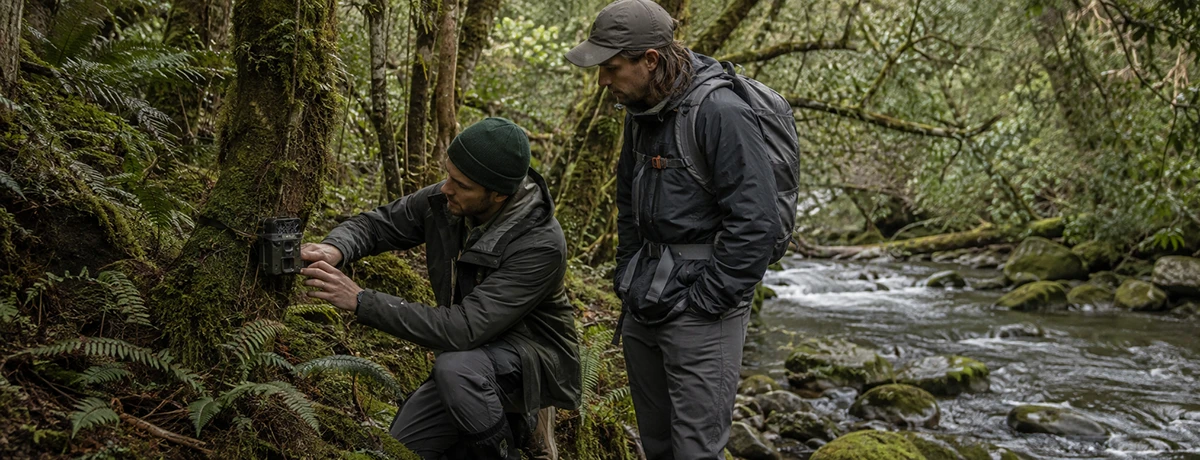
 Scientific reviewer Dr Jo Pollard discusses the involvement of hunters in conserving what’s left of New Zealand’s original species.
Hunters and Conservation
Ecological perspective
New Zealand has one of the highest ratios of introduced species to native species in the world. Introductions and other dramatic changes began less than 1000 years ago.
NZ’s terrestrial ecology had evolved in isolation from other land, for 85 million years, and without mammals. Animals such as birds (wrens) and insects (weta) occupied the usual rodent role; birds filled the role of large grazing/browsing herbivores; the large predators were birds including the largest eagle ever to have existed (Haast’s eagle (Hieraaetus moorei), with a wingspan of nearly 3 metres.
Human arrival from Polynesia in 1280 CE brought competition, predation and habitat change. For instance the Pacific rat the kiore (Rattus exulans) accompanied the humans and likely played a major role in extinctions of birds, insects, lizards and frogs, and may have changed forest makeup by eating seeds. Large herbivores such as the Moa (Order Dinornithiformes), occupying the shoreline to the alpine zone, were rapidly hunted to extinction by humans. Avian predators died off with them. Habitat was cleared on a large scale, initially by fire.
European settlers brought many species, and the clearing of habitat for timber, farms and settlements. In 1840, when NZ became a British colony, much of the eastern South Island and approximately one-third of the North Island had been converted from forest to grassland, fernland, or shrubland.
Immigration of species to NZ is ongoing. For example, recent self-introductions of birds include the royal spoonbill (Platalea regia, first seen breeding 1949) and the barn owl (Tyto alba, first breeding 2008). These species are officially considered native.
Need for habitat
NZ ecologists consider that to save native species, preservation of habitat is vital:
“conservation of species is conservation of habitats … ‘The continued survival of the full genetic heritage of any species is not possible outside the habitat to which it has become adapted as the result of long evolutionary processes’ … ”
– Dr Carolyn King, 1984, quoting Dr Christoph Imboden (international bird conservationist)
“The hardy species are the ones that have survived on the main islands for at least a hundred years in company with the whole range of predators and other habitat changes, and therefore are able to come to some sort of terms with them …What conditions do they require? Simply to be left alone in their natural habitat, and enough of it …”
– King, 1984.
For the less hardy, endangered species, King notes that conservation of habitat on its own is not sufficient – they also need informed management.
Evidence-based prioritisation of areas to protect using spatial data and a conservation prioritisation tool (Zonation) was demonstrated by NZ ecologist Dr John Leathwick and his colleagues (2023). King & Forsyth (2021) consider management tiers need to include highest priority areas, outside of which “the ancient, pre-human environment has been replaced by a new world,” where management might follow “… some wise principle of co-existence between man and nature, even if it has to be a modified kind of man and a modified kind of nature” (quoting ecologist Charles Elton).
The role of hunters
Thoughtful, knowledgeable management of NZ’s remaining native species is required. It must recognise that human intervention with nature often has unexpected and adverse effects.
Fortunately, hunters have long seen the need for careful stewardship of public land and some (e.g. Fiordland Wapiti Foundation, Sika Foundation, NZDA branches), have taken that on, knowledgeably, skilfully and resourcefully – managing deer and other animals as well as maintaining tracks and huts – enabled by volunteers, collaboration and some granted funds.
In a land far changed from pre-human times, hunters have been providing pragmatic wildlife management that hasn’t cost the public anything, and does not place native biota at risk.
For policy makers, the relevance of hunter involvement lies in outcomes. These can be organised, transparent, and measurable against ecological indicators.
What Hunters Already Contribute:
· Introduced herbivore control
· Trapping to protect threatened species
· Track and hut maintenance
· Field data and biological sampling
· Zero direct cost to the taxpayer
· Social giveback – Foodbanks
· Health and wellbeing for participants
Example
In 2003 the Fiordland Wapiti Foundation (FWF) assumed management of 190,000 ha of Fiordland National Park (a daunting place for many humans to even step foot in) having promised the government it would manage the area’s wapiti (Cervus canadensis) herd at low density, minimising their impacts on Fiordland’s biodiversity. Twenty-three years later the FWF is accommodating the needs of recreational hunters, WARO (commercial game animal recovery operations), the Game Animal Council (GAC), the Department of Conservation (DOC), conservation groups, the Southland community and the public.
The FWF’s primary focus is a low impact of wapiti on vegetation (monitored by DOC), through keeping numbers low, retaining a high quality hunting herd. Measurements on harvested deer are used to inform science-based management, with independent scientific consultation. The Foundation also: maintains tracks and huts so that access is retained; traps rats and stoats to protect endangered whio (Hymenolaimus malacorhynchos, blue duck) (in keeping with DOC’s management elsewhere); collects hunter observations on rare birds; represents hunters and their interests (in submissions, presentations, meetings); and supplies grateful humans with venison (it began the Venison to Foodbank movement, donating 18 tonnes of wild venison to Foodbank during Covid and continuing to donate thousands of kilograms since then. This social project has been taken up by other deer hunter groups across New Zealand.)
Potential
The Game Animal Council promotes and supports hunter-led (and commercial hunting opportunities in) conservation. It will soon be presenting survey results that describe the current contribution of hunters to harvesting wild animals and conservation.
Enabling environmental care are many “silver bullet” technologies available off the shelf, that have transformed efficiency of mammal control – self resetting traps, smart traps, camera traps, and thermal imaging. A simple bait station (enviroMate100TM) dispenses lure at programmed times and can be used to assess small mammal population numbers, or to lure them to traps, or to feed them poison – e.g. fast-acting cyanide, of low risk to the next consumers in the food chain.
Strengths of ground-based mammal control include flexibility with technique, intensity and targets; ability to use dogs to locate targets; humane killing; safety to native biota; and the ability to collect samples to inform wildlife management.
New technologies enable smart decisions based on intelligent data collection. For example, stable isotope analysis on tissue (such as fur, or collagen) reveals the diet of an animal. RAT (rapid antigen) tests can be used in surveillance for Bovine tuberculosis (Mycobacterium bovis, Tb) infection in wildlife4, as can serology testing (on blood samples taken under winter conditions).
A natural path
Environmental stewardship centred around hunting follows the natural course of predation, and outcomes can be monitored. Major contributions are: managing effects of introduced animals; minimising negative impacts of management on non-target species, and animal welfare; and utilising animal resources.
Increased uptake and support for hunter-based conservation can help put an end to large, expensive, risky, Government schemes (widescale poisoning, species eradication, genetic modification). A helpful new focus for the government, to conserve what’s left of NZ’s original biota, would be protecting habitat and learning about its ecology.
For references:
See Pollard, J. “Towards Ethical and Effective Conservation of New Zealand’s Natural Heritage”Conservation 2025, 5(3), 47;
https://doi.org/10.3390/conservation5030047
Naturalised species, i.e. self-replicating
See King, C. Immigrant Killers. Oxford Univ. Press, Auckland, 1984; Peltzer, D. et al. J. Roy. Soc. N.Z. 2019, 49, 412-439; Leathwick, J. & Byrom, A. N.Z. J. Ecol.,2023, 47, 1-15; Linklater, W. & Steer, J. Conserv. Lett. 2018, 11:e12593.
e.g. CervidTB STAT-PAK, for use in deer
Latest 1080 Science Press Releases
 https://1080science.co.nz/wp-content/uploads/2026/08/nz-possum.webp
600
1200
Dr J.C. Pollard, BSc (Hons), PhD, Zoology
http://1080science.co.nz/wp-content/uploads/2013/04/logo1-300x79.jpg
Dr J.C. Pollard, BSc (Hons), PhD, Zoology2026-08-08 08:58:352026-09-26 07:36:27Managing Wild Animal Populations Without the Cruelty of 1080
https://1080science.co.nz/wp-content/uploads/2026/08/nz-possum.webp
600
1200
Dr J.C. Pollard, BSc (Hons), PhD, Zoology
http://1080science.co.nz/wp-content/uploads/2013/04/logo1-300x79.jpg
Dr J.C. Pollard, BSc (Hons), PhD, Zoology2026-08-08 08:58:352026-09-26 07:36:27Managing Wild Animal Populations Without the Cruelty of 1080 https://1080science.co.nz/wp-content/uploads/2025/01/OIA.jpg
600
1200
Dr J.C. Pollard, BSc (Hons), PhD, Zoology
http://1080science.co.nz/wp-content/uploads/2013/04/logo1-300x79.jpg
Dr J.C. Pollard, BSc (Hons), PhD, Zoology2025-01-12 04:10:302026-08-08 09:36:46DOC Response to OIA Request on 1080 Poison Use and Karoro Deaths
https://1080science.co.nz/wp-content/uploads/2025/01/OIA.jpg
600
1200
Dr J.C. Pollard, BSc (Hons), PhD, Zoology
http://1080science.co.nz/wp-content/uploads/2013/04/logo1-300x79.jpg
Dr J.C. Pollard, BSc (Hons), PhD, Zoology2025-01-12 04:10:302026-08-08 09:36:46DOC Response to OIA Request on 1080 Poison Use and Karoro Deaths https://1080science.co.nz/wp-content/uploads/2023/09/piwakawaka-FB.jpg
600
1200
Dr J.C. Pollard, BSc (Hons), PhD, Zoology
http://1080science.co.nz/wp-content/uploads/2013/04/logo1-300x79.jpg
Dr J.C. Pollard, BSc (Hons), PhD, Zoology2023-09-19 00:01:122023-09-19 03:58:39In-depth Response: Independent Scientist, Jo Pollard, Debunks OSPRI’s Claim that a 10-Year Study Proves Forests Remain Vibrant Despite 1080 Poison Usage!
https://1080science.co.nz/wp-content/uploads/2023/09/piwakawaka-FB.jpg
600
1200
Dr J.C. Pollard, BSc (Hons), PhD, Zoology
http://1080science.co.nz/wp-content/uploads/2013/04/logo1-300x79.jpg
Dr J.C. Pollard, BSc (Hons), PhD, Zoology2023-09-19 00:01:122023-09-19 03:58:39In-depth Response: Independent Scientist, Jo Pollard, Debunks OSPRI’s Claim that a 10-Year Study Proves Forests Remain Vibrant Despite 1080 Poison Usage!
